


What a Level 2 EV Charger Install Really Costs in Florida in 2026
Florida homeowners should usually budget for EV charger hardware, electrician labor, permit work, and possible electrical-panel upgrades before buying a Toyota EV or plug-in hybrid. A basic Level 2 home setup may stay near the lower end if the panel is ready and the charger sits close to the electrical source, while older homes, outdoor parking, trenching, or a 200-amp panel upgrade can move the project much higher. At Toyota of Coconut Creek, we recommend getting an installation quote before choosing between a Toyota bZ, Toyota C-HR EV, RAV4 Plug-in Hybrid, or Prius Plug-in Hybrid because the home setup can change the smartest vehicle choice.
For a Boca Raton homeowner with a two-car garage and a newer electrical panel, a Level 2 charger may be a straightforward addition that supports daily EV ownership. For a Fort Lauderdale apartment driver without assigned charging, a regular hybrid or plug-in hybrid may be easier to live with. That is why we talk about charging access as part of the buying conversation, not as an afterthought.
This guide explains Level 1 versus Level 2 charging, Florida cost ranges, permit and HOA questions, panel-upgrade risk, local South Florida conditions, and the Toyota ownership scenarios we review with shoppers before they commit to a full EV or plug-in hybrid.
Definition: EV home charger installation is the process of adding home electrical equipment that can recharge an electric or plug-in hybrid vehicle. A Level 2 charger usually uses a 240-volt circuit and often requires licensed electrical work, permits, and inspection. For drivers in Coconut Creek and nearby South Florida communities, it provides faster home charging and more predictable daily range.
- Level 1 vs Level 2 EV Charging for Florida Homes
- Florida EV Charger Installation Cost Breakdown
- Local Charging Considerations for Coconut Creek Homes
- Ownership Cost Analysis: When a Home Charger Pays Off
- Contrarian Insight: A Plug-in Hybrid May Be Smarter
- Key Takeaways
- EV Home Charger Install Cost Florida Questions
Compare Toyota Electrified Vehicles
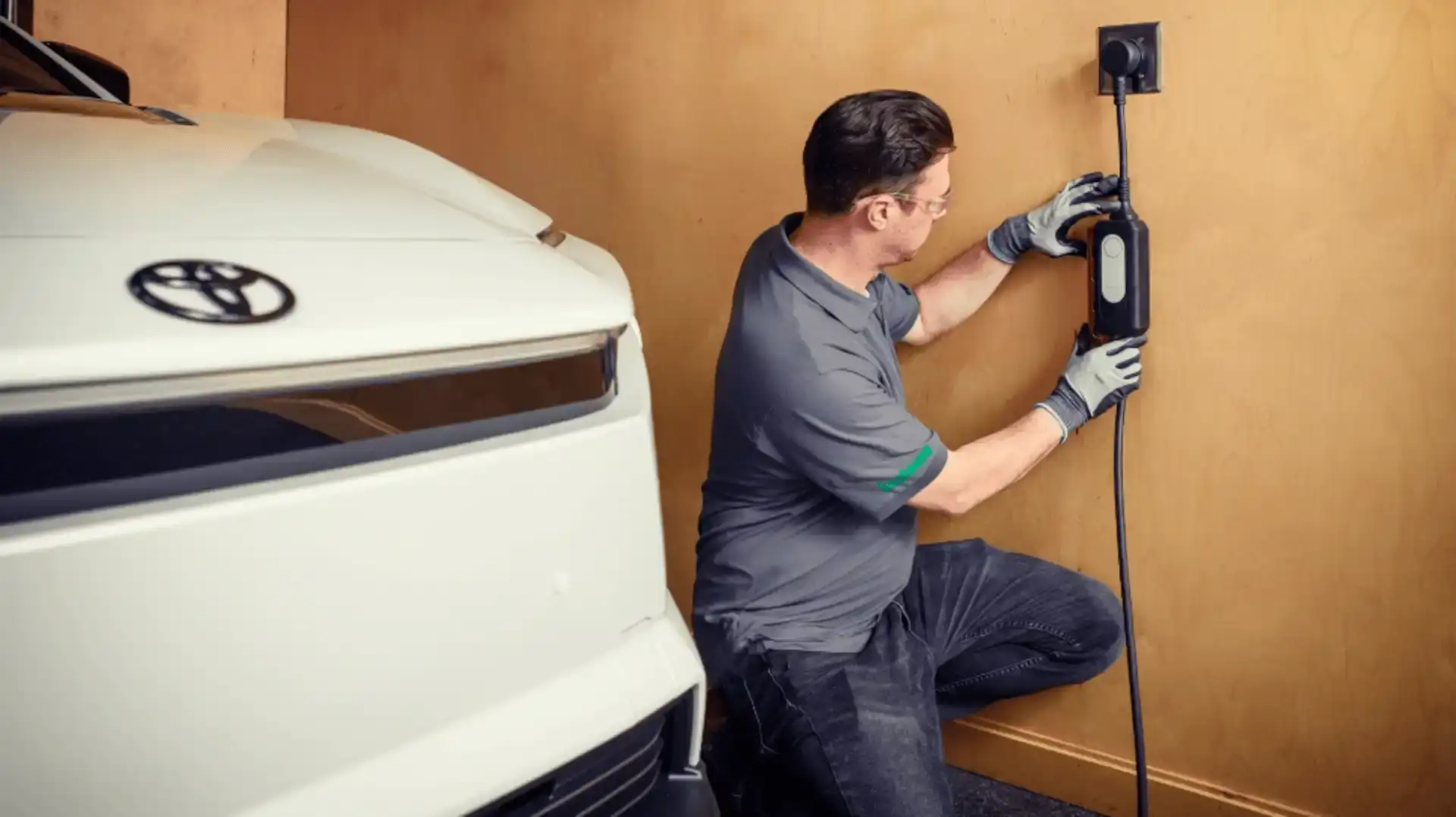
Level 1 vs Level 2 EV Charging for Florida Homes
Key Takeaway: Level 1 charging can work for light plug-in hybrid use, but Level 2 charging is the home setup we recommend for most Toyota EV shoppers who want dependable overnight charging.
What Level 1 Charging Really Gives Toyota EV and PHEV Owners
Level 1 charging uses a standard household outlet, usually 120 volts, and is the simplest way to plug in at home. We treat Level 1 as a convenience option, not the ideal long-term setup for every electrified Toyota. It can make sense for a Prius Plug-in Hybrid driver who travels short distances and can stay plugged in for long stretches, but it may feel too slow for a full EV owner who needs to restore meaningful range every night.
For a Fort Lauderdale apartment driver with no dedicated parking outlet, we recommend being honest about charging access before choosing a full EV. If you cannot plug in consistently, a Prius Hybrid or Prius Plug-in Hybrid may fit your routine better than a full battery-electric Toyota. For a Boca Raton homeowner who parks in a private garage, Level 1 can be a temporary start, but we would still price a Level 2 setup before finalizing a long-term EV plan.
- Level 1 uses a standard 120-volt outlet.
- It usually requires no wall-mounted charger purchase.
- It is slow compared with Level 2 charging.
- It can work for short plug-in hybrid commutes.
- It is usually not the best daily setup for a full EV.
- It depends heavily on how long the vehicle can stay plugged in.
What Level 2 Charging Adds: 240V Power, Faster Charging, and Daily Convenience
Level 2 charging uses 240-volt power and is the setup we usually discuss with shoppers considering Toyota bZ, Toyota C-HR EV, RAV4 Plug-in Hybrid, and Prius Plug-in Hybrid ownership. It can charge much faster than a standard outlet, which makes overnight charging more realistic for a full EV and more convenient for a plug-in hybrid. Toyota of Coconut Creek’s electrified-vehicle resources note that Toyota BEVs and PHEVs include dual-voltage charging capability, and Toyota’s Treehouse support can help simplify Level 2 installation planning for eligible Toyota shoppers.
Based on our experience at Toyota of Coconut Creek, Level 2 charging is the better home setup when a driver wants to treat an EV like a normal daily vehicle rather than a vehicle that needs constant charging math. For a Coconut Creek homeowner commuting across Broward County, the practical benefit is simple: plug in at night, wake up with a more useful charge, and spend less time depending on public stations.
32A vs 48A Chargers: Which Setup Makes Sense for a Toyota Owner?
A 32-amp Level 2 charger can be enough for many plug-in hybrid owners and some lower-mileage EV drivers, especially when the vehicle sits overnight. A 48-amp hardwired charger can make sense for higher-mileage EV drivers, but it may also require more electrical capacity, more careful load calculation, and more installation cost. We recommend asking a licensed electrician for a load calculation before assuming a bigger charger is automatically the better value.
For a Coral Springs family with a RAV4 Plug-in Hybrid, we would usually compare a practical 32A Level 2 setup first because the goal is overnight convenience, not overbuilding the garage. For a Boca Raton homeowner planning a full EV and driving long daily miles, a 48A hardwired setup may be worth pricing. What we see here in South Florida is that the right amperage depends on the vehicle, commute, panel capacity, and how long the car sits at home each night.
| Charging Setup | Typical Power | Home Requirement | Best For |
|---|---|---|---|
| Level 1 outlet | 120V | Standard outlet, safe location, long parking time | Plug-in hybrid driver with short daily mileage |
| 32A Level 2 | 240V | Dedicated circuit and proper installation | RAV4 Plug-in Hybrid or lower-mileage EV owner |
| 40A Level 2 | 240V | Higher-capacity dedicated circuit | Homeowner who wants faster overnight charging |
| 48A hardwired Level 2 | 240V | Hardwired charger and sufficient panel capacity | Full EV driver with longer daily routes |
| Panel-upgrade install | Varies by home | Load calculation, permits, possible utility coordination | Older home with limited electrical capacity |
| Ideal Use Case | Match power to driving routine | Confirm with licensed electrician | Toyota shopper choosing between EV, PHEV, and hybrid |
Based on Toyota official website.
Florida EV Charger Installation Cost Breakdown: Hardware, Labor, Permits, and Panel Upgrades
Key Takeaway: Most Florida Level 2 charger projects depend on four costs: the charger, the circuit, permitting or inspection, and any panel work needed to support the load.
Typical EV Charger Install Cost Scenarios in Florida
Florida cost guides commonly place typical Level 2 charger installations in broad ranges, often around $800 to $2,500 or $900 to $2,200 for many standard projects, with higher costs when the electrical panel, distance, trenching, or outdoor conditions add work. Hardware can range from a few hundred dollars to more than $1,000, and labor changes quickly based on garage layout and panel location. We recommend treating every online range as a planning estimate, not a final quote.
| Install Scenario | Typical Cost Driver | Why It Matters | Ideal Use Case |
|---|---|---|---|
| Simple Level 2 near panel | Short wiring run and ready panel | Usually the cleanest and least complex setup | Boca Raton garage homeowner |
| Wall-mounted charger | Hardware plus electrician labor | Better daily convenience and cable management | Toyota bZ or C-HR EV shopper |
| Hardwired 48A charger | Higher circuit capacity and fixed installation | Can support faster charging where the home can handle it | Long-distance EV commuter |
| Outdoor charger | Weather-rated equipment, placement, and protection | South Florida rain and heat make placement important | Pompano Beach driveway parker |
| Condo or HOA install | Approval process, assigned parking, shared electrical access | Permission can be as important as price | Deerfield Beach condo owner |
| Panel upgrade | Electrical capacity, permit work, utility coordination | Can push the project far beyond a simple charger install | Older Coconut Creek home with limited panel capacity |
Based on Toyota official website.
The key difference between a simple EV charger install and an expensive one is usually the electrical work behind the charger. We recommend pricing the charger, wiring, breaker, permit, inspection, and panel capacity before choosing a full EV. If the home is already ready for Level 2, a Toyota EV becomes much easier to justify; if the home needs major electrical work, a plug-in hybrid may be the smarter step.
Which Charger Setup Should You Choose Based on Your Home and Toyota Model?
For a Coconut Creek homeowner with an older panel who wants a 48A charger, we recommend getting a licensed electrician’s load calculation before buying the vehicle because a panel upgrade can change the total ownership math. For a Coral Springs family with a RAV4 Plug-in Hybrid, we recommend a practical Level 2 setup if daily charging matters, because a plug-in hybrid does not always need the most aggressive charging hardware. For a Boca Raton full EV commuter, we recommend a Level 2 setup that can support regular overnight charging because relying on public charging every week can become inconvenient.
- If you drive a Toyota bZ or C-HR EV daily, we recommend Level 2 charging because overnight range recovery matters.
- If you drive a RAV4 Plug-in Hybrid mostly around Coral Springs, we recommend pricing a practical 32A Level 2 setup first.
- If you live in a Fort Lauderdale apartment without assigned charging, we recommend checking charging access before choosing a full EV.
- If your Coconut Creek home has an older panel, we recommend a load calculation before choosing charger amperage.
- If your charger must sit outdoors, we recommend weather-rated equipment and professional placement.
Our customers who move into Toyota EVs usually want predictable home charging. Our plug-in hybrid shoppers usually want flexibility, electric driving for short trips, and gasoline backup for longer routes. We help both groups choose a vehicle around the home setup they can actually use.
Visit us at our Coconut Creek showroom when you are comparing Toyota EV and plug-in hybrid options. We can talk through your commute, parking setup, charging access, and budget before you choose between Toyota bZ, Toyota C-HR EV, RAV4 Plug-in Hybrid, Prius Plug-in Hybrid, or a regular Toyota hybrid. Our team can also point you to our electrified-vehicle resources at https://www.toyotaofcoconutcreek.com/electrified-vehicles/ and review available inventory through our website. Call us at 954-448-7257 if you want to confirm current electrified Toyota availability before you visit. We can help you request pricing, review finance options, and decide whether home charging should shape your next Toyota purchase.
Local Charging Considerations for Coconut Creek, Coral Springs, Boca Raton, and Fort Lauderdale Homes
Key Takeaway: South Florida home charging depends on more than charger price; garage layout, HOA rules, flood exposure, summer heat, and permit needs can all affect the right plan.
Broward County Permits, HOA Rules, Garage Layout, and South Florida Weather
A single-family homeowner in Coconut Creek may only need an electrician, permit handling, and a charger location close to the electrical panel. A Deerfield Beach condo owner may need written HOA approval, assigned-space review, electrical access details, and installation rules before the vehicle purchase makes sense. A Pompano Beach driver parking outdoors should also think about rain, heat, and charger placement before assuming a garage-style install will work.
For Coconut Creek and Broward County homeowners, we recommend checking four items before committing to a Toyota EV: panel capacity, charger location, permit or inspection needs, and parking control. A Level 2 charger is only convenient if it is installed where you actually park every night. Our team treats home charging as a local ownership issue because South Florida heat, humidity, rain, and shared-parking rules can change the best recommendation.
| Local Situation | What to Check | Risk if Skipped | Best For |
|---|---|---|---|
| Coconut Creek garage | Panel location, circuit capacity, charger wall position | Unexpected wiring cost | Single-family Toyota EV shopper |
| Coral Springs older home | Panel age and load calculation | Panel upgrade surprise | Homeowner considering 48A Level 2 |
| Boca Raton two-car garage | Vehicle position and cable reach | Charger installed in the wrong spot | Daily EV commuter |
| Fort Lauderdale condo | HOA approval and assigned parking rights | No usable home charging after purchase | Condo or apartment driver |
| Pompano Beach outdoor parking | Weather rating, water exposure, mounting location | Poor durability or inconvenient use | Driveway charger owner |
| Deerfield Beach shared parking | Written permission and billing rules | Installation delay or denial | Condo buyer considering EV ownership |
Based on Toyota official website.
We also recommend reviewing service needs as part of electrified ownership. Toyota EVs and plug-in hybrids still need tires, brakes, cabin filters, wipers, software checks, and multi-point inspections. Our service center can help you plan scheduled maintenance while your home charging setup supports the daily driving side of ownership.
Schedule Electrified Toyota Service
Stop by our showroom at 5201 W Sample Rd if you want a local team to help you think through charging before buying. We serve Coconut Creek, Coral Springs, Boca Raton, Pompano Beach, Fort Lauderdale, and Deerfield Beach, so we understand how garages, condos, summer heat, coastal humidity, and parking rules affect EV ownership here. We can review ToyotaGuard Platinum, ToyotaCare, service planning, and model fit while you compare electrified vehicles. Start with our website at https://www.toyotaofcoconutcreek.com/ or call 954-448-7257 for current availability. If your charger quote looks high, we can also help you compare a full EV against a plug-in hybrid or regular hybrid before you decide.
Ownership Cost Analysis: When a Home Charger Pays Off and When It Does Not
Key Takeaway: A Level 2 charger pays off fastest when the driver plugs in often, drives enough miles to replace gasoline use, and avoids major electrical upgrades.
The home-charger payoff depends on driving pattern more than charger advertising. A Boca Raton commuter who drives daily, charges nightly, and has a simple garage install may get real value from Level 2 charging. A Deerfield Beach driver who only charges once a week, pays for a difficult outdoor install, or faces a panel upgrade may need more time for the charger cost to make financial sense.
Our advice is to compare three numbers before buying: the charger quote, the vehicle payment, and the realistic weekly charging habit. If those three work together, a Toyota EV or plug-in hybrid can be a strong ownership decision. If the quote is high and charging will be inconsistent, a regular hybrid may be the cleaner value.
- If you drive daily and charge nightly, we recommend pricing Level 2 charging before choosing a Toyota EV.
- If your install needs a panel upgrade, we recommend comparing EV, plug-in hybrid, and hybrid total cost.
- If you only drive short local trips, we recommend checking whether Level 1 can support a plug-in hybrid routine.
- If you rely on public charging, we recommend calculating time cost as well as charging cost.
- If you plan to sell the home, we recommend asking whether a clean charger install adds buyer appeal in your neighborhood.
Contrarian Insight: A Plug-in Hybrid May Be Smarter Than a Full EV if Your Home Install Is Expensive
Key Takeaway: A plug-in hybrid can be the smarter Toyota choice when home charging is possible but expensive, limited, or inconsistent.
What most buyers do not realize is that the best electrified Toyota is sometimes the one that fits the home, not the one with the largest battery. If a Fort Lauderdale condo driver cannot install a dependable charger, a full EV may create more daily friction than expected. In that situation, Prius Plug-in Hybrid, RAV4 Plug-in Hybrid, or a regular Toyota hybrid can keep efficiency high while reducing dependence on perfect charging access.
For a Coral Springs homeowner facing a costly panel upgrade, we recommend comparing the total cost of a full EV plus electrical work against a plug-in hybrid that can still use Level 1 or a lower-cost Level 2 setup. For a Coconut Creek homeowner with an easy garage install, the full EV may be the stronger choice. The smarter recommendation depends on the charger quote, parking control, commute distance, and whether gasoline backup adds peace of mind.
- Choose a full EV if home Level 2 charging is convenient and affordable.
- Choose a plug-in hybrid if charging is available but not always guaranteed.
- Choose a regular hybrid if home charging is not realistic.
- Choose a lower-amperage Level 2 setup if it fits your PHEV routine without overbuilding.
- Choose an electrician quote before choosing final charger amperage.
Key Takeaways
- Level 2 charging is usually the best home setup for Toyota EV shoppers.
- Florida install cost depends on hardware, labor, permits, wiring distance, and panel capacity.
- A panel upgrade can change the total ownership case for a full EV.
- Condo and HOA drivers should verify charging approval before buying.
- A plug-in hybrid may fit better if home charging is costly or inconsistent.
EV Home Charger Install Cost Florida Questions for Toyota Shoppers
How much does it cost to install a Level 2 EV charger in Florida?
Many Florida Level 2 charger installations fall into broad ranges around $800 to $2,500, but the real quote depends on charger hardware, wiring distance, permit needs, panel capacity, and outdoor or garage placement. We recommend getting a written electrician quote before buying a Toyota EV because a simple garage install and a panel-upgrade install are very different ownership costs.
Do I need a panel upgrade for a home EV charger?
A panel upgrade is not always required, but older homes or higher-amperage charger plans may need one after a licensed electrician completes a load calculation. Our team recommends checking panel capacity before choosing a 48A charger or full EV. For a Coconut Creek homeowner with an older electrical panel, that review can prevent a surprise cost after the vehicle purchase.
Can I install an EV charger in a condo or HOA community in Florida?
Condo and HOA installation depends on assigned parking, building electrical access, association rules, and written approval. We recommend getting permission and an installation quote before choosing a full EV if you live in Fort Lauderdale, Deerfield Beach, or another shared-parking community. If approval is uncertain, a Prius Plug-in Hybrid or regular Toyota hybrid may be easier to own.
Should I install a charger before buying a Toyota EV or plug-in hybrid?
We recommend pricing the charger before you buy, but you do not always need to complete the install first. The quote helps you choose the right Toyota. If the install is simple, a Toyota EV may fit well. If the install is expensive or uncertain, a RAV4 Plug-in Hybrid, Prius Plug-in Hybrid, or regular hybrid may be smarter.
0 comment(s) so far on What a Level 2 EV Charger Install Really Costs in Florida in 2026