


Hurricane Prep for Your Toyota: A Coconut Creek Driver’s Checklist
Coconut Creek drivers should prepare their Toyota before hurricane season by checking tires, battery condition, brakes, wipers, lights, fluids, fuel or charge level, emergency supplies, insurance documents, evacuation route, and post-storm inspection plans. At Toyota of Coconut Creek, we recommend treating storm prep as a vehicle-readiness routine, not a last-minute errand. For a Coral Springs family driving a Highlander or RAV4, that means the vehicle should be ready for school pickup, fuel lines, sudden rain, possible evacuation traffic, and a full cabin of passengers and supplies before a storm watch creates a rush.
South Florida drivers have to plan for more than wind. Heavy rain, standing water, downed branches, traffic, fuel demand, power outages, and flood exposure can all affect whether your Toyota is ready when you need it. A well-maintained vehicle cannot stop a storm, but it can reduce the chance of being stuck with weak wipers, low tire pressure, a failing battery, or an empty tank when conditions change quickly.
This guide gives Toyota owners in Coconut Creek, Coral Springs, Boca Raton, Pompano Beach, Fort Lauderdale, and Deerfield Beach a practical hurricane checklist, including pre-storm service, emergency-kit planning, safe parking, evacuation readiness, and post-flood inspection guidance.
Definition: Hurricane car prep is the process of getting a vehicle ready for storm season, evacuation traffic, flooding risk, and post-storm safety. For Toyota owners in Coconut Creek and nearby South Florida communities, it includes maintenance checks, emergency supplies, fuel or charging plans, safe parking choices, and a plan for inspection after flood exposure.
- Pre-Storm Toyota Checklist: Fuel, Tires, Battery, Brakes, and Wipers
- Evacuation Readiness: What to Keep in Your Toyota Before a Hurricane
- Local Hurricane Prep for Coconut Creek, Coral Springs, Boca Raton, and Fort Lauderdale Drivers
- Local Driving Insight: Where to Park Your Toyota Before Landfall
- Service Expertise: What to Check After Driving Through Floodwater
- Key Takeaways
- Hurricane Prep for Your Car in Coconut Creek FL: Toyota Owner Questions
Schedule Pre-Storm Toyota Service
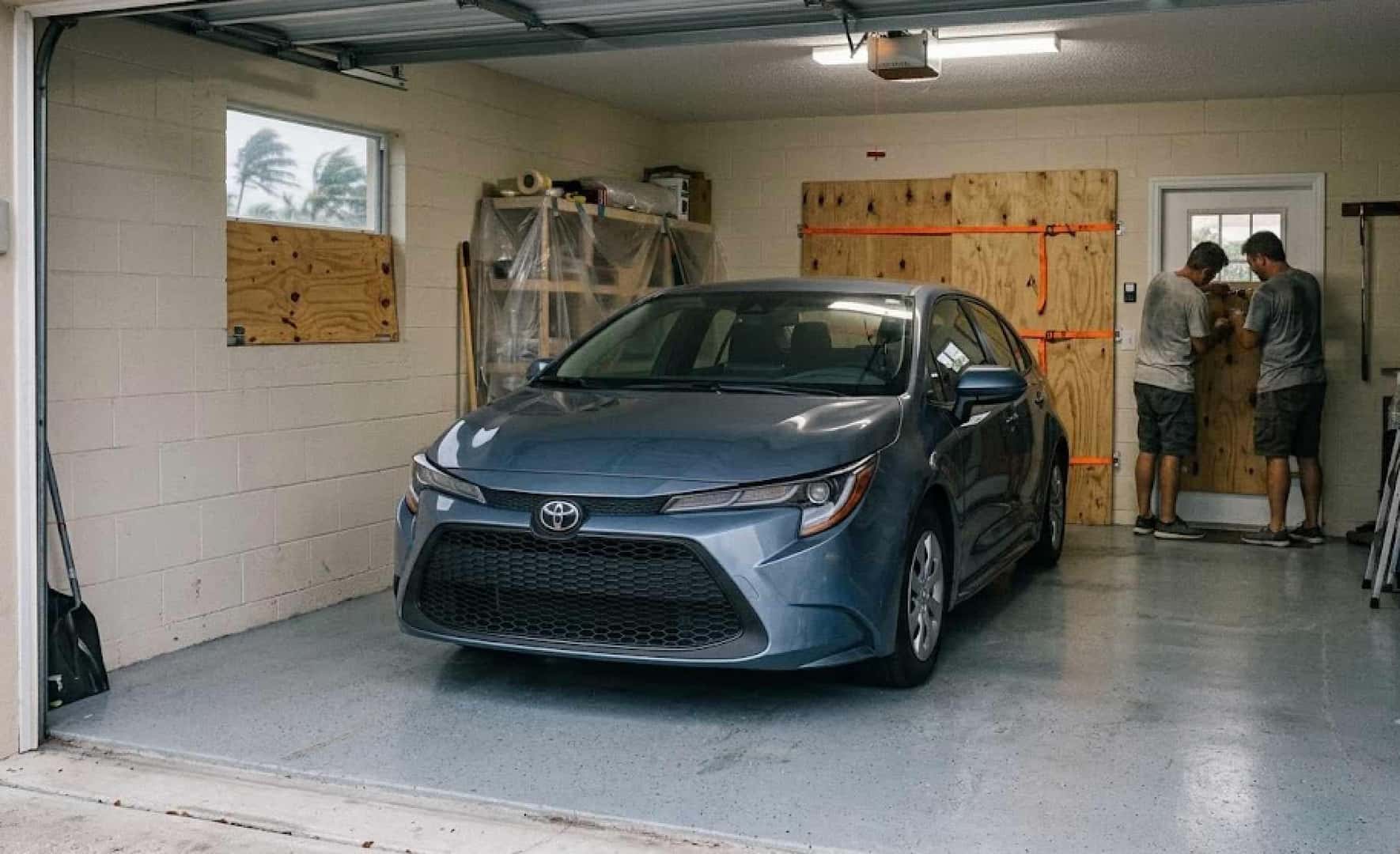
Pre-Storm Toyota Checklist: Fuel, Tires, Battery, Brakes, and Wipers
Key Takeaway: The safest hurricane vehicle prep starts before the storm track feels urgent. Fuel, tires, battery, brakes, wipers, lights, fluids, and documents should be checked while service appointments and supplies are still available.
The 7-Day Vehicle Prep Window Before a Storm
The best time to prepare your Toyota for hurricane season is before there is a named storm in the forecast, but the seven-day window before potential landfall is when many drivers finally act. We recommend using that week to fill the gas tank or charge early, check tire pressure, inspect tread depth, test the battery, replace worn wipers, top off washer fluid, check exterior lights, and gather vehicle documents. Once a storm watch is issued, fuel stations, stores, and service appointments can become harder to use.
For a Boca Raton commuter with a Camry Hybrid, this preparation reduces the chance of a weak 12-volt battery, low tire pressure, or poor visibility creating a problem in storm traffic. For a Coral Springs family driving a Highlander, the checklist matters even more because family vehicles often carry kids, pets, luggage, supplies, and medications during evacuation decisions.
- Fill your gas tank early or charge your electrified Toyota before demand spikes.
- Check tire pressure and tread depth before heavy rain arrives.
- Replace worn windshield wipers before visibility becomes urgent.
- Test the battery, especially if it is older or slow to start.
- Check brake feel, warning lights, exterior lights, and fluid levels.
- Take photos of the vehicle, license plate, VIN, registration, and insurance card.
Gas, Hybrid, Plug-in Hybrid, and EV Prep Differences
Gas Toyota owners should focus on fuel, tires, battery, brakes, lights, wipers, and emergency supplies. Hybrid owners should do the same, while also remembering that a hybrid still depends on regular vehicle systems such as the 12-volt battery, tires, brakes, and cooling systems. A hybrid badge does not replace maintenance. It simply changes how the powertrain works.
Plug-in hybrid and EV owners should charge early, not at the last minute. A Fort Lauderdale apartment driver with a Prius Plug-in Hybrid should avoid depending on public charging right before an outage. If a charger is busy or offline, gasoline backup becomes valuable. A Toyota EV owner with home charging should charge ahead of the storm, know nearby public charging alternatives, and avoid letting the vehicle sit at a low state of charge during uncertain power conditions.
Review Toyota Electrified Options
What Our Service Team Recommends Checking Before Hurricane Season
Our service team recommends a practical storm-season inspection before hurricane threats become urgent. The most important items are tires, battery, brakes, wipers, fluids, exterior lights, cabin filter, AC performance, and any warning lights. South Florida heat and stop-and-go traffic can already stress batteries, tires, and cooling systems. Hurricane season adds heavy rain, traffic delays, and possible evacuation miles, so the vehicle needs to be ready before supplies and appointments tighten.
| Pre-Storm Item | What to Check | Why It Matters | Best Timing |
|---|---|---|---|
| Fuel or charge | Fill tank or charge early | Fuel and charging demand can spike before storms | 7 days before possible impact |
| Tires | Pressure, tread, uneven wear | Wet roads and standing water require good tire condition | Before heavy rain starts |
| Battery | Starting strength and age | Heat and stop-and-go traffic can expose a weak battery | Early in hurricane season |
| Wipers | Streaking, cracking, chatter | Visibility can change quickly during storm bands | Before storm watch conditions |
| Brakes | Noise, vibration, pedal feel | Evacuation traffic requires predictable stopping | Before long-distance travel |
| Documents | Insurance, registration, VIN photos | Documentation helps after damage or evacuation | Before watches are issued |
Based on Toyota official website.
Evacuation Readiness: What to Keep in Your Toyota Before a Hurricane
Key Takeaway: A Toyota hurricane kit should support the people who ride in the vehicle, not just the vehicle itself. Families, seniors, EV owners, pet owners, students, and commuters all need slightly different supplies.
Emergency Kit Checklist for Toyota Owners
A good hurricane vehicle kit should include more than jumper cables. We recommend water, non-perishable snacks, phone chargers, a flashlight, spare batteries, first-aid supplies, a small tire inflator, basic tools, a portable jump starter, medication copies, insurance documents, registration, pet supplies, child supplies, and a written evacuation plan. Keep digital copies backed up, but do not rely only on your phone because power, signal, and charging access can all become unreliable during and after a storm.
| Driver Profile | Must-Have Items | Why It Matters | Toyota Prep Tip |
|---|---|---|---|
| Family with kids | Water, snacks, wipes, chargers, child supplies | Evacuation traffic can take longer than expected | Check cargo space before packing day |
| Senior driver | Medication list, printed contacts, flashlight, water | Simple written information helps if phones fail | Keep documents in a waterproof pouch |
| EV or PHEV owner | Charging plan, adapters, gas backup if PHEV | Outages can change charging access quickly | Charge early and do not wait for the final forecast |
| Pet owner | Pet food, leash, carrier, records, water bowl | Shelter and hotel options may require records | Test pet carrier fit in the cargo area |
| Commuter | Phone charger, tire inflator, rain gear, route map | Work travel can overlap storm preparation | Check tires and wipers before the commute week |
| Student driver | Contacts, insurance copy, flashlight, portable charger | Young drivers need clear instructions if conditions change | Create a written family pickup and evacuation plan |
Based on Toyota official website.
The best emergency kit is the one that matches the people in the car. A Deerfield Beach senior driver may need medication copies and printed contacts more than extra sports gear. A family with small children needs snacks, wipes, chargers, and patience for long traffic. A pet owner needs records, leash, food, and a carrier plan. We recommend building the kit around your real passengers and then checking the vehicle systems that support the trip.
Use-Case Recommendations by Driver Type
For a Coral Springs family with a Highlander, we recommend packing early and using the cargo area to separate emergency supplies from luggage. For a Boca Raton commuter with a Camry Hybrid, we recommend a battery test, tire inspection, and fuel plan before storm traffic begins. For a Fort Lauderdale apartment driver with a Prius Plug-in Hybrid, we recommend charging early and keeping gasoline backup in mind because shared charging may become busy or unavailable.
For a Pompano Beach driver parking outdoors, we recommend documenting vehicle condition with photos before the storm and choosing parking that avoids trees, low-lying areas, and loose debris. For a student driver, we recommend writing down a simple family plan: where to meet, who to call, what route to use, and when not to drive. Storm prep should remove confusion before conditions get stressful.
Visit us before hurricane season peaks if your Toyota needs a tire check, battery test, brake inspection, wiper replacement, or multi-point inspection. Our service team can help you prepare for heavy rain, traffic, and possible evacuation driving before the schedule gets tight. You can use our online scheduler at https://www.toyotaofcoconutcreek.com/service/schedule-service/ or call our service department at 954-758-9803. We recommend scheduling early because storm-season service demand can rise fast when a system starts tracking toward South Florida. We can also help with genuine Toyota parts, wipers, filters, tires, and ToyotaCare-related maintenance questions.
Local Hurricane Prep for Coconut Creek, Coral Springs, Boca Raton, and Fort Lauderdale Drivers
Key Takeaway: Broward County hurricane prep should include local alerts, evacuation planning, parking choices, flood awareness, and a plan for post-storm vehicle inspection if the car is exposed to water.
Flood Zones, Evacuation Routes, Parking Choices, and Broward County Alerts
Coconut Creek drivers are not always in the same situation as coastal drivers, but that does not mean storm prep can be ignored. Broward County residents should know how to receive alerts, understand evacuation guidance, and plan routes before a storm. Drivers near Pompano Beach, Deerfield Beach, Fort Lauderdale, or low-lying streets should think carefully about flood exposure, parking choices, and whether the vehicle may be needed for evacuation or recovery.
For Broward County Toyota owners, we recommend checking local emergency alerts, planning more than one route, filling the tank or charging early, and parking away from low-lying water and tree limbs when possible. A Toyota that is mechanically ready can still be damaged by poor parking choices, flood exposure, or last-minute driving through water. Local planning is part of vehicle protection.
| Local Scenario | Main Risk | Recommended Prep | Best Driver Fit |
|---|---|---|---|
| Coconut Creek garage | Power outage and heavy rain | Fuel early, document vehicle condition, check service items | Family SUV owner |
| Coral Springs family route | Traffic and school or family coordination | Print route, pack child supplies, check tires and brakes | Highlander or RAV4 driver |
| Boca Raton commuter | Long traffic delays | Full tank, battery test, charger, water, snacks | Camry Hybrid or Corolla owner |
| Pompano Beach outdoor parking | Flooding, branches, wind debris | Avoid trees and low areas, photograph vehicle before storm | Driveway or street parker |
| Fort Lauderdale condo garage | Low-level garage flooding | Review building guidance and avoid flood-prone levels | Condo or apartment resident |
| Deerfield Beach flood-prone street | Standing water after storm bands | Do not drive through unknown water depth | Senior driver or local commuter |
Based on Toyota official website.
We also recommend planning for the days after the storm. Even if your Toyota starts and drives, floodwater, debris, potholes, and wet brakes can create hidden issues. If your vehicle was exposed to standing water, smelled musty, showed warning lights, made brake noise, or drove through debris, schedule an inspection before assuming everything is fine.
Contact Toyota of Coconut Creek
Stop by our showroom or service center at 5201 W Sample Rd if you want help getting your Toyota ready for storm season. We serve Coconut Creek, Coral Springs, Boca Raton, Pompano Beach, Fort Lauderdale, and Deerfield Beach, so we understand the local roads, rain patterns, evacuation concerns, and service needs that affect South Florida drivers. We can help with wipers, batteries, tires, brakes, filters, fluids, ToyotaGuard Platinum questions, ToyotaCare maintenance, and post-storm inspection support. Start with our service scheduler or call 954-758-9803 for service guidance. If you are shopping for a Toyota before hurricane season, we can also help you choose a model that fits your family, cargo, fuel, hybrid, or EV needs.
Local Driving Insight: Where to Park Your Toyota Before Landfall
Key Takeaway: The safest parking spot before a hurricane is not always the most convenient one. Avoid trees, loose debris, low-lying areas, and flood-prone garage levels when safer alternatives are available.
Parking choices can protect or expose your Toyota during storm conditions. A covered garage can help protect against wind debris, but an underground or low-level garage can be a bad choice if flooding is possible. Outdoor parking may be unavoidable, but we recommend avoiding large trees, weak branches, construction materials, loose signs, and low-lying areas where water collects.
For a Pompano Beach driver parking outside, we recommend photographing the vehicle from all sides before the storm, including the license plate, wheels, windshield, roof, and interior. For a Fort Lauderdale condo resident, we recommend following building guidance and avoiding flood-prone levels if management gives relocation instructions. For a Coconut Creek family with a garage, remove objects that could shift, strike the vehicle, or block exit access after the storm.
- Park away from trees and loose debris when possible.
- Avoid low-lying parking and flood-prone garage levels.
- Photograph the vehicle before the storm for documentation.
- Keep keys, documents, and emergency items easy to access.
- Do not block the vehicle with heavy items that may be hard to move later.
Service Expertise: What to Check After Driving Through Floodwater
Key Takeaway: If your Toyota was exposed to floodwater, do not assume it is safe because it starts. Water can affect brakes, fluids, electrical systems, sensors, undercarriage components, and hybrid or EV systems.
If your Toyota was sitting in deep water or water reached sensitive components, do not restart it until it can be inspected. Restarting a flooded vehicle can turn a repairable issue into a much larger problem. If you had to drive through shallow standing water, pay attention afterward to brake noise, steering changes, warning lights, musty odors, vibration, pulling, or unusual electrical behavior.
For a Coconut Creek Toyota owner after flood exposure, we recommend scheduling an inspection for brakes, wheel areas, undercarriage, fluids, cabin air, electrical connectors, sensors, and hybrid or EV components where applicable. Floodwater can carry salt, dirt, chemicals, and debris. Even when the vehicle looks fine from the outside, hidden moisture can affect safety and long-term reliability.
| Post-Storm Sign | Possible Concern | Recommended Action | Urgency |
|---|---|---|---|
| Vehicle sat in floodwater | Electrical, engine, hybrid, or fluid contamination risk | Do not restart until inspected | High |
| Brake grinding or pulsing | Water, grit, or corrosion around brake components | Schedule brake inspection | High |
| Warning lights | Sensor or electrical issue | Schedule diagnosis | High |
| Musty odor | Moisture inside cabin or vents | Check carpet, filters, and HVAC system | Moderate |
| Pulling or vibration | Tire, wheel, alignment, or debris issue | Inspect tires and undercarriage | Moderate to High |
| Fluid discoloration | Water contamination risk | Professional inspection before further driving | High |
Schedule Post-Storm Inspection
Key Takeaways
- Prepare your Toyota before storm watches create service and fuel demand.
- Check tires, battery, brakes, wipers, lights, fluids, documents, and emergency supplies.
- Gas, hybrid, plug-in hybrid, and EV owners need different fuel or charging plans.
- Park away from trees, debris, and flood-prone areas when possible.
- Do not restart a flooded vehicle before inspection.
Hurricane Prep for Your Car in Coconut Creek FL: Toyota Owner Questions
How should I prepare my Toyota before a hurricane in Coconut Creek?
Prepare your Toyota before a hurricane by filling the tank or charging early, checking tire pressure and tread, testing the battery, replacing worn wipers, checking brakes and lights, gathering documents, packing emergency supplies, and planning your route. We recommend scheduling service before storm demand rises so small maintenance needs do not become evacuation problems.
Should I fill my gas tank or charge my Toyota before a hurricane?
Yes. We recommend filling your gas tank or charging your electrified Toyota before fuel stations and chargers become crowded. Gas and hybrid drivers should avoid waiting until the last forecast update. Plug-in hybrid and EV drivers should charge early, keep route options in mind, and avoid relying on last-minute public charging during storm preparation.
Where should I park my car during a hurricane in South Florida?
Park in a secure, higher, covered location if available, but avoid low-lying or flood-prone garage levels. If you park outdoors, stay away from trees, loose debris, construction materials, and areas where water collects. We also recommend taking photos of your Toyota before the storm, including the VIN, license plate, exterior, wheels, windshield, and interior.
What should I do if my Toyota drives through floodwater?
If your Toyota was exposed to floodwater, do not ignore it. If the vehicle sat in deep water, do not restart it until it has been inspected. If you drove through shallow water, watch for brake noise, warning lights, musty odor, vibration, pulling, or electrical issues. We recommend scheduling an inspection for brakes, fluids, undercarriage, sensors, electrical systems, and hybrid or EV components.
0 comment(s) so far on Hurricane Prep for Your Toyota: A Coconut Creek Driver’s Checklist